

The most familiar way to borrow against your home isn’t automatically the best fit for an addition. Financing a home addition in Oregon may involve a home equity loan or line of credit, a cash-out refinance, or a renovation loan that includes project costs in a mortgage. Start by comparing your available equity, whether you’re buying or refinancing, and how you want to repay the funds.
Affordability matters, but the payment is only part of the decision. Loan structure also affects when funds are available, how they’re released, and whether the financing fits your plans for the home.
This guide compares common financing options, explains what lenders consider, and outlines how to weigh costs and repayment terms. Use the decision points to identify a financing path that may suit your addition and household budget.
Key Takeaways
- Compare loan options by how they use your home equity, release funds, and shape repayment, not by the monthly payment alone.
- Down payment assistance may affect how much cash you need upfront; understand the program’s eligibility and repayment terms.
- Review your debt-to-income ratio alongside the full housing payment to gauge how a new loan may fit your budget.
- Use a consistent set of criteria to compare banks and credit unions, then match the financing approach to the scope of your addition.
Down payment requirements
Down payment needs depend on the loan type. Conventional mortgages may allow 3% down, while a standard down payment is often 20% or higher. FHA 203(k) borrowers with a FICO® score of at least 580 can put down 3.5%; borrowers with a score between 500 and 579 need 10%. Eligible veterans may qualify for a VA renovation loan with no down payment.
Oregon Housing and Community Services (OHCS) offers programs designed to help low- to moderate-income Oregonians buy primary residences. FirstHome offers assistance equal to 4% or 5% of the loan amount. OHCS’s NextStep pairs a fixed-rate first mortgage with a second mortgage that may be repayable or forgivable. Work with an approved lender to determine eligibility and how assistance applies toward your financing.
It is a 30-year deferred second mortgage with 0% interest and a stated APR of 0.012%; 50% is forgiven at year 15. At least 10% of the award must be paid as a home improvement grant.
| Option | Down payment or assistance | Key consideration |
|---|---|---|
| FHA 203(k) | 3.5% or 10% | Depends on credit score |
| VA renovation loan | 0% for eligible borrowers | Veteran eligibility |
| OHCS programs | Approved lender determines eligibility | |
| Portland assistance | Includes a home improvement grant requirement |
Permits are generally required for home additions, and local zoning, setbacks, or historic-district rules may affect plans. Confirm applicable requirements with the relevant local government. To plan financing, define the project scope, obtain contractor bids, account for repair needs, and then compare lender terms and assistance eligibility.
Cash-out refinancing and construction loans
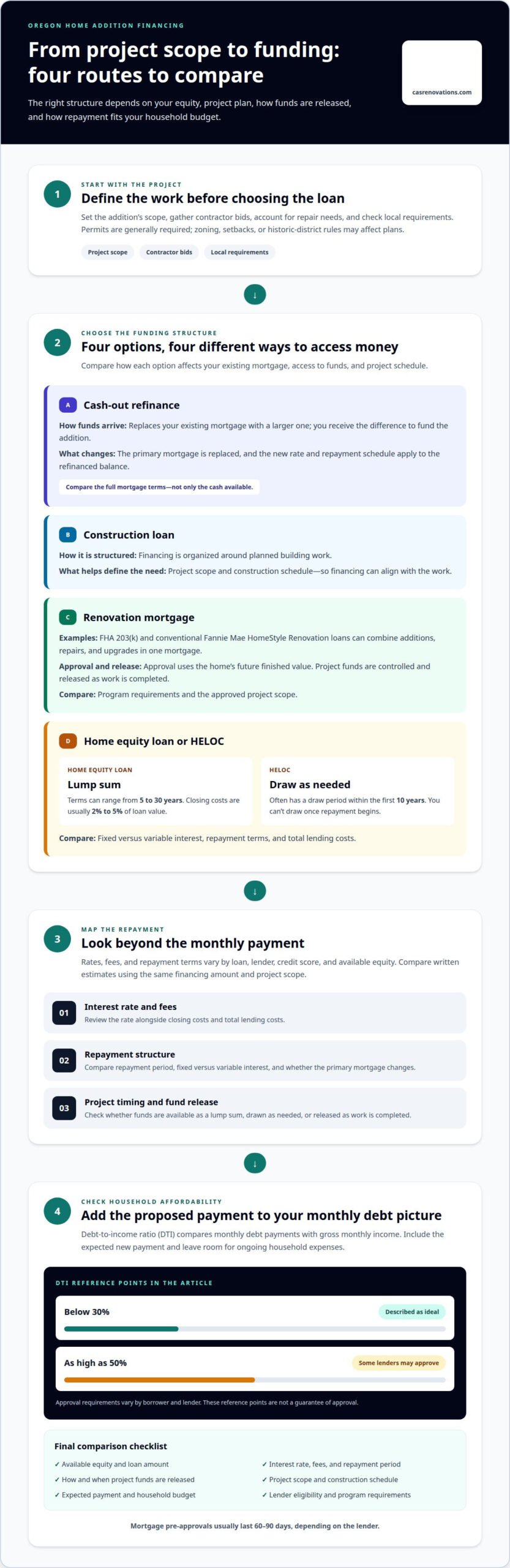
Oregon homeowners can compare cash-out refinancing, construction loans, renovation mortgages, home equity loans, and HELOCs. Rates, fees, and repayment terms vary by loan, lender, credit score, and available equity.
Cash-Out Refinancing
Cash-out refinancing replaces an existing mortgage with a larger one, and the homeowner receives the difference to fund an addition. Unlike a home equity loan or HELOC, it changes the primary mortgage, so the rate and repayment schedule apply to the refinanced balance. Compare the full mortgage terms, not just the cash available for construction.
Construction Loans
A construction loan finances building work through lending structured around a planned project. Its purpose differs from a cash-out refinance, which replaces an existing mortgage, and a HELOC, which provides access to revolving credit. For an addition in Washington County, the project scope and construction schedule help define the financing need and how funds align with the work.
Renovation Loans
FHA 203(k) and conventional Fannie Mae HomeStyle Renovation loans can combine additions, repairs, and upgrades in one mortgage. Renovation loan approval uses the home’s future finished value, and funds for project work are controlled and released as work is completed. HomeStyle is a conventional alternative; compare program requirements and the approved scope.
Home Equity Loans and HELOCs
A home equity loan provides a lump sum, while a HELOC lets a homeowner draw funds as needed. Home equity loan terms can range from 5 to 30 years, with closing costs usually 2% to 5% of loan value. HELOCs often have a draw period within the first 10 years; borrowers can’t draw once repayment begins. Compare fixed versus variable interest and total lending costs. For project planning alongside financing, entire-home renovations can bring connected updates into one coordinated scope.
Debt-to-income ratios and mortgage affordability
Debt-to-income ratio (DTI) compares monthly debt payments with gross monthly income. A lower DTI leaves more room in the housing budget, while a new mortgage payment can raise the ratio. Below 30% is described as ideal; some mortgage lenders may approve borrowers with a DTI as high as 50%. Mortgage approval requirements can vary by borrower and lender. For financing a home addition in Oregon, include the expected new payment when assessing your monthly debt.
Credit score also shapes mortgage qualification and available options. Borrowers with scores from 620 to 660 may qualify for a home loan, and some mortgage products may be accessible with scores in the 500s. A FICO score of 780 or higher may open access to select mortgage opportunities. Compare the expected payment, loan amount, and renovation scope rather than treating a score as the only deciding factor.
FHA, VA, and USDA programs have different eligibility rules and renovation options. FHA 203(k) can finance renovation work, while eligible borrowers may qualify for VA renovation financing with no down payment. These programs don’t fit every residence or project, so match the loan’s purpose and limits to the planned addition.
Flex Lending mortgage products can be compared alongside FHA, VA, and USDA options. Review each product’s eligibility, interest rate, fees, repayment structure, and permitted renovation scope. Those terms determine whether the financing suits the borrower’s income and project timeline.
Mortgage pre-approvals usually last 60-90 days, depending on the lender. Use that period to refine the project amount and compare financing before the approval expires. For financing a home addition in Oregon, list current monthly debts, estimate the proposed housing payment, then assess how the combined amount affects DTI. Keep room in the household budget for ongoing expenses after the addition is complete.
Comparing credit unions and banks
For an Oregon addition, compare credit unions and banks by the loan terms they offer, not by institution type alone. Both may provide mortgage or home equity financing, but interest rates, fees, approval criteria, and repayment structures depend on the specific product and borrower.
Request comparable written estimates for the same financing amount and project scope. Review the interest rate alongside closing costs, repayment period, and whether the product is a lump-sum loan or a credit line. Mortgage closing costs can range from 3% to more than 6%, so include those costs when evaluating the total borrowing amount.
Compare the approval process, too. Lenders assess income, existing debts, credit history, and home value when considering an application. For renovation lending, the project plan and contractor bids may also matter. A homeowner buying a home and financing improvements may face a different process from someone refinancing an existing residence.
- Interest rate: Compare the rate and whether it is fixed or variable.
- Fees: Include closing costs and other charges in the total.
- Repayment: Consider payment structure and the length of the loan.
- Project fit: Confirm the financing can cover the planned addition and related renovation work.
- Approval: Compare how income, credit, equity, and project documents affect qualification.
For example, if you’re weighing a fixed home equity loan against a HELOC, compare each lender’s complete terms, not just the initial rate. Request estimates for the same borrowing amount and compare the total cost over the expected repayment period. This makes differences clearer without assuming a bank or credit union is automatically less expensive.
Once you’ve compared lending terms, a defined project scope can help clarify the funding amount. Plan your home addition project around the spaces and improvements you want to bring together.
Interest rates and repayment terms vary by financing product and borrower. Mortgage closing costs can range from 3% to more than 6%, so compare them along with other charges when assessing the total cost.
CAS Construction & Renovations: Entire-Home Renovations
CAS Construction & Renovations helps homeowners coordinate renovation plans through Whole-Home Renovations. If an addition is part of broader changes to your home, a coordinated scope can help the new space work with the rooms and features around it.
Planning a kitchen or bathroom update alongside an addition? CAS Construction & Renovations also offers Kitchen Remodeling, Bathroom Remodeling, and Outdoor Living & Hardscaping. These services can support a wider vision for how your home functions, inside and out. A clear scope gives you a practical basis for setting project priorities and considering how financing fits the work.
When you’re ready to discuss your renovation plans, contact CAS Construction & Renovations.
Shape a Plan That Fits Your Home
A thoughtful approach to financing a home addition in Oregon starts with a clear picture of how you want your home to work after construction. Consider how the new space will connect with existing rooms, improve daily routines, and support your longer-term plans. A well-defined vision can help keep project decisions and financing conversations aligned as the work takes shape.
If your plans reach beyond the addition itself, connected updates may also matter. CAS Construction & Renovations offers Kitchen Remodeling, Bathroom Remodeling, and Outdoor Living & Hardscaping, so homeowners can consider improvements across indoor and outdoor spaces. The right scope depends on the home and the priorities you want the finished project to serve.
When you’re ready to discuss the work and clarify a project direction, contact CAS Construction & Renovations. A considered plan is a strong starting point for creating a home that feels more complete and better suited to the way you live.
Frequently Asked Questions
How do home equity loan and HELOC qualification requirements differ in Oregon?
Both typically require lenders to assess your credit, income, existing debts, and home equity. A home equity loan provides a set amount upfront, while a HELOC provides access to a credit line during its draw period. For example, a homeowner with phased construction payments may prefer access to funds over time, while a single large payment may suit a lump-sum loan. Compare each lender’s eligibility criteria and repayment terms.
Are Oregon grants, rebates, tax credits, or loan programs available for home additions or accessibility improvements?
Oregon programs include purchase-focused down payment assistance and some home repair financing, rather than a general addition grant. OHCS programs support homebuyers, while Portland’s Down Payment Assistance Loan is for buyers. For accessibility work, distinguish repair assistance from purchase assistance and confirm that a program covers the specific improvement before including it in your project budget.
What are the risks of financing a home addition, including cost overruns, liens, and reduced home equity?
The main risks include borrowing more than planned, increasing debt secured by your home, and having less equity after financing. Unplanned work or material changes can increase funding needs. Unpaid contractors or suppliers can also create lien concerns, so keep signed agreements, invoices, and proof of payment organized. Before work begins, set a written scope, document approved changes, and track payments against completed work to keep costs and obligations visible.
What are current interest rates, fees, and loan terms for home addition financing in Oregon?
Interest rates vary by loan product, lender, credit score, and available equity; compare whether a rate is fixed or variable. Home equity loan closing costs are usually 2% to 5% of the loan value, while mortgage closing costs can range from 3% to more than 6%. Home equity loan terms can range from 5 to 30 years, and HELOCs often have a draw period within the first 10 years.